Choosing among the top electric motor production line manufacturers requires more than comparing machine lists. A capable supplier connects each stage, from stator lamination and winding to rotor assembly, balancing, and final testing. Small details matter. A winding station that handles the required wire gauge, or a test bench that records repeatable results, can affect output and quality every day.
This guide examines how manufacturers differ in automation, line configuration, production capacity, and technical support. It also considers practical evidence: sample cycle times, available process documentation, commissioning plans, and service response expectations. A complete Electric Motor Production Line may combine automated handling with manual workstations, depending on motor design and expected volume. More automation is not always better. It can add cost and make changeovers harder when product models vary.
Supplier claims deserve careful review. Ask how quoted capacity was measured, which motor specifications were tested, and what inspection equipment is included. Factory references and clear acceptance criteria can make comparisons more reliable. Still, no checklist removes every uncertainty; real production conditions often reveal gaps that a proposal cannot show. The following overview offers a grounded way to assess manufacturers and identify questions worth asking before selecting a partner.
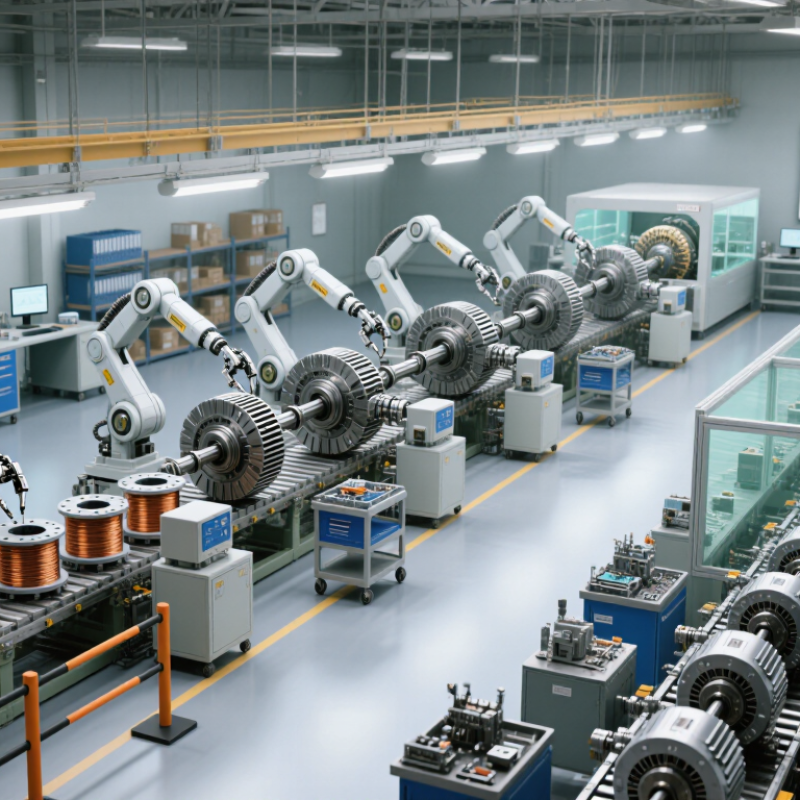
An electric motor production line is a coordinated sequence of workstations that turns individual parts into a tested motor. Depending on the design, it may handle stator winding, rotor assembly, shaft fitting, housing installation, and final inspection. Some lines rely heavily on automated machines; others combine equipment with skilled operators. The right arrangement depends on motor size, production volume, and how often models change.
A stator winding station feeds insulated copper wire into slots in a laminated steel core. Operators or sensors check the winding pattern before the part moves onward. At later stations, presses fit bearings, tools tighten fasteners, and fixtures hold components in place. Not glamorous work, but small alignment errors matter. A motor may look finished and still produce unwanted noise or heat.
Testing is built into the process, not left until the end. Common checks measure electrical resistance, insulation performance, vibration, and rotation. A failed unit can be traced to its station when production records connect test results with assembly data. No line is perfect. Sensors need calibration, and overly fast cycles can hide inconsistent assembly. Practical manufacturers also leave room for maintenance and careful manual checks, especially when a product design changes.
An electric motor production line is a sequence of precision tasks, not just a row of machines. It usually begins with electrical steel sheets cut by stamping presses or laser systems. The sheets are stacked and bonded to form the stator core. Copper wire is then wound into coils and inserted into the slots. Automatic winders improve repeatability, but operators still need to check insulation and coil position. Small defects matter.
Rotor assembly follows, using equipment for shaft fitting, balancing, and, in some designs, magnet placement. The stator and rotor are joined, then the motor is impregnated with resin or varnish to protect its windings. After machining and assembly, test stations measure vibration, temperature rise, insulation resistance, and electrical performance.
The International Energy Agency’s 2011 report, Energy-Efficiency Policy Opportunities for Electric Motor-Driven Systems, estimates that these systems use about 45% of global electricity.
That scale makes reliable production and testing important. Not always straightforward. A fast line can still produce inconsistent units if material variation or process settings go unnoticed. Manufacturers should match automation to motor type, volume, and test requirements; the most automated option is not automatically the best fit.
Top Electric Motor Production Line Manufacturers?
How to Evaluate Electric Motor Production Line Manufacturers
Evaluating a production line manufacturer starts with your motor specifications and target output. Ask how the equipment handles winding, rotor assembly, balancing, testing, and final inspection. A capable supplier should explain each process clearly, not hide behind broad claims. Request sample cycle-time data and ask what conditions produced it. A fast quoted speed may depend on ideal staffing or a narrow product range.
Look closely at changeover time, tooling access, and the space needed for maintenance. Watch a similar line operating, if possible. Notice whether operators can reach fixtures comfortably and read test results without leaving their stations. Ask for documented acceptance criteria, training plans, and spare-parts recommendations. These details affect production long after installation. Small things matter.
Discuss integration early. Confirm how the line exchanges data with existing systems and how faults are recorded. Ask who supports commissioning, and how quickly technical help is available across time zones. Request references from facilities with comparable motor designs, then speak with their production and maintenance teams. No checklist catches everything. Factory conditions can be messy, and proposed output may not match your mix of products. Build time for trial runs, adjustments, and operator feedback into the schedule.
| Evaluation dimension | What to assess | Evidence to request | How to compare proposals |
|---|---|---|---|
| Motor and process coverage | Whether the line supports the motor types, sizes, and manufacturing steps in the project scope, such as winding, insertion, impregnation, assembly, and testing. | A process-flow diagram, equipment list, and sample process plan for the specified motor designs. | Compare the included operations and identify any steps that remain manual, outsourced, or outside the supplier’s scope. |
| Capacity and cycle time | Quoted output, cycle time, shift assumptions, changeover time, and constraints at each workstation. | A capacity calculation stating product mix, operating hours, planned downtime, staffing, and the line’s bottleneck station. | Compare proposals using the same product mix and operating assumptions; distinguish rated machine speed from expected saleable output. |
| Product flexibility | Ability to handle planned variations in motor dimensions, winding patterns, materials, and product models. | A list of supported product variants, changeover procedures, required tooling, and any design limits. | Check the time, labor, and tooling needed to switch between products, and confirm that future variants are within the proposed design envelope. |
| Quality controls and traceability | In-process checks, final electrical tests, defect handling, and the ability to link test results to individual motors or production batches. | Inspection and test plans, sample reports, data-retention details, and the proposed method for recording serial or batch identifiers. | Verify that required tests and acceptance limits are agreed in writing and that records can be exported in a usable format. |
| Automation and system integration | Controls architecture, operator interfaces, data exchange, and connection requirements for plant systems. | Controls and network diagrams, interface specifications, data-point lists, and details of any required licenses or third-party software. | Confirm compatibility with the plant’s existing systems and clarify who is responsible for integration, cybersecurity, and commissioning. |
| Safety and compliance | Risk assessment, guarding, emergency stops, electrical safety, and compliance with regulations applicable at the installation site. | Risk-assessment documentation, safety-system details, electrical documentation, and a list of applicable standards and regulations. | Check the requirements for the destination market and confirm which party supplies documentation, validation, and any required conformity assessment. |
| Installation and commissioning | Site preparation, utilities, delivery, installation, commissioning, acceptance testing, and operator training. | A project schedule, site-readiness checklist, acceptance-test plan, training plan, and clear list of customer-supplied resources. | Compare the full project scope, milestones, acceptance criteria, and potential costs for travel, installation, and production ramp-up. |
| Service and spare parts | Warranty terms, technical support, maintenance requirements, spare-parts availability, and response arrangements. | Warranty conditions, recommended spare-parts list, maintenance schedule, support channels, and service coverage for the installation location. | Compare coverage and exclusions, expected parts lead times, and the availability of qualified service support during the planned operating period. |
| Total cost of ownership | Purchase price plus installation, tooling, software, utilities, maintenance, consumables, and other recurring costs. | An itemized quotation with exclusions, payment milestones, recurring fees, and stated assumptions for operating costs. | Compare the same scope and evaluation period; document uncertain costs rather than treating them as included. |
Leading manufacturers of electric motor production lines do more than supply machines. They connect winding, rotor assembly, balancing, testing, and material handling into a coordinated process. Strong suppliers ask about motor size, expected output, product variation, and available floor space before proposing equipment. That matters. A line designed around one motor model may struggle when specifications change.
Reliable manufacturers also explain how each station affects quality and uptime. For example, automated winding can improve repeatability, while calibrated testing equipment helps identify insulation or performance issues. Ask for sample test records, acceptance criteria, and details about operator training. A polished presentation is not proof of dependable production. Even a capable supplier may underestimate commissioning time, so request a realistic installation schedule and clear support arrangements.
Tips: Compare complete line layouts, not just equipment prices. Check how quickly the system can change between models, and ask who provides spare parts and maintenance guidance. If possible, review a comparable installation. The best fit may not be the most automated one; sometimes a simpler line is easier to maintain.
Production lines need testing and quality-control systems capable of verifying motor efficiency. This chart compares the IEC efficiency classes for a 1.1 kW, four-pole, 50 Hz motor; higher classes indicate higher minimum nominal efficiency.
Source: IEC 60034-30-1 efficiency-class values. These are standard benchmarks, not manufacturer or product rankings.
Top Electric Motor Production Line Manufacturers?
Motor production is moving toward flexible automation, connected inspection, and tighter process control. A line may combine robotic winding, laser marking, and camera-based checks. Operators can review torque, vibration, and electrical test results on one dashboard. That makes defects easier to trace before motors reach final assembly.
Digital monitoring is becoming more practical as sensors grow less costly. Temperature readings from a winding station, for example, can reveal drift before insulation quality suffers. Some factories also use digital simulations to test line changes before modifying equipment. Useful, but not magic. Poor sensor placement can produce tidy charts and weak decisions.
Manufacturers are also adapting lines for shorter runs and varied motor designs. Quick-change fixtures and programmable winding systems can reduce setup work, though staff still need training to handle exceptions. Energy use matters, too. Efficient drives, improved furnace controls, and reduced scrap can lower resource consumption. The trade-off is real: new equipment requires investment, and integration often takes longer than planned. Progress can be uneven. A careful pilot with clear quality checks may tell a factory more than a rushed full-line upgrade.
It turns separate components into a tested motor through connected workstations. The sequence varies with motor design, production volume, and model changes.
Stations can wind copper wire into a laminated steel stator, assemble the rotor, fit the shaft, and install the housing. Presses fit bearings, while tools tighten fasteners.
Small alignment errors can cause noise or heat, even when a motor looks finished. Fixtures help hold components steady. Details matter.
Checks may measure electrical resistance, insulation performance, vibration, and rotation. Production records can link results to assembly steps, helping teams trace failed units.
Robots may wind coils, while cameras inspect parts and lasers mark components. Connected dashboards can show torque, vibration, and electrical test results.
Temperature readings at a winding station may reveal process drift before insulation quality suffers. But poor sensor placement can create neat charts and weak decisions.
Quick-change fixtures and programmable winding systems can reduce setup work for shorter runs. Staff still need training to handle exceptions. Plans do not cover everything.
Efficient drives, improved furnace controls, and less scrap can reduce resource use. New equipment costs money, and integration may take longer than expected. A small pilot can expose issues before a full-line change.
An Electric Motor Production Line is an integrated manufacturing system that transforms raw materials and components into finished motors through a coordinated sequence of operations. Depending on the motor design, key stages may include core and shaft preparation, winding, assembly, balancing, and electrical and mechanical testing. Equipment such as winding machines, presses, assembly stations, and inspection systems helps maintain consistent quality and production efficiency.
When evaluating manufacturers of these production lines, consider their engineering experience, ability to tailor equipment to product requirements, automation and quality-control capabilities, integration support, and after-sales service. Leading providers typically offer solutions suited to different production volumes and motor types, while emerging technologies are making production more connected and adaptable. Trends such as smarter process monitoring, improved automation, energy-efficient equipment, and data-based quality checks can help manufacturers reduce waste, respond to changing demand, and maintain reliable performance.