White Paper: Optimizing High-Volume Brushed Stator Production Lines
In the rapidly evolving global electric motor market, permanent magnet brushed DC (PMDC) motors continue to power critical industrial, automotive, and consumer applications—ranging from power tools and windshield wipers to HVAC blowers and personal appliance drives. Although brushless motor technology has gained significant traction, brushed DC motors remain the dominant choice for applications demanding high starting torque, robust design simplicity, and exceptional cost-efficiency. Achieving maximum productivity in brushed motor manufacturing requires an advanced, highly automated Brushed Stator Production Line engineered to minimize manual labor, eliminate copper fill variability, and maintain rigorous dimensional integrity.
Key Engineering Metric: Modern high-speed brushed stator manufacturing demands process stability capable of supporting multi-shift operation with first-pass yields exceeding 99.5%. Key bottlenecks—such as insulating paper insertion, magnetic tile gluing, pole winding tension variance, and varnish trickling—are now entirely automated through servo-driven closed-loop feedback systems.
Core Structural Modules of a Fully Automated Brushed Stator Line
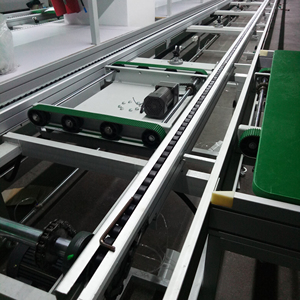
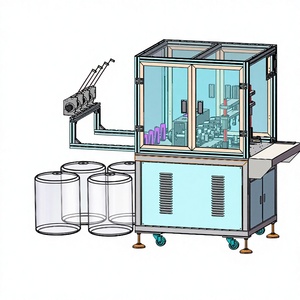
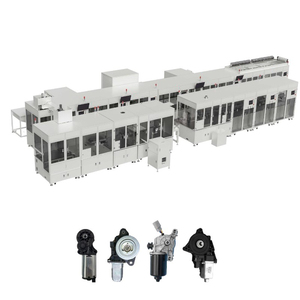
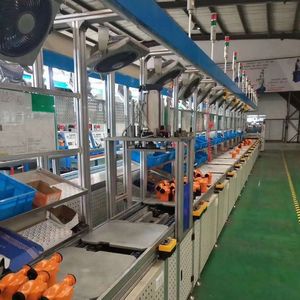
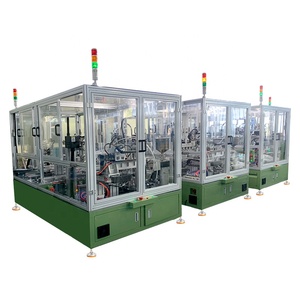
A turnkey brushed stator automated production line engineered by Suzhou Haplin integrates several high-precision sub-systems linked by palletized shuttle conveyors, pick-and-place gantry units, and real-time vision inspection sensors. Below is the systematic breakdown of an industry-standard manufacturing sequence:
1. Housing & Core Stacking
Automated feeding and pressing of steel stator housings. Ensures precise concentricity and inner-diameter dimensional tolerances prior to magnet insertion.
2. Magnet Tile Gluing & Insertion
High-precision two-component epoxy dispensing combined with automatic permanent magnet tile orientation, insertion, and high-frequency induction heating curing.
3. Slot Insulation Paper Inserting
Programmable servo-driven paper feeding, forming, cutting, and insertion. Provides dielectric protection across varying stack lengths without damaging insulation borders.
4. Automatic Pole Winding
Multi-axis needle or flyer winding heads featuring electronic dynamic tension control. Guarantees tight, uniform copper wire layout even at maximum speeds.
5. Terminal Lead Crimping & Welding
Precision stripping, lead termination, and hot-staking spot welding. Achieves ultra-low electrical resistance joints with automated tensile strength validation.
6. End-of-Line Electrical Testing
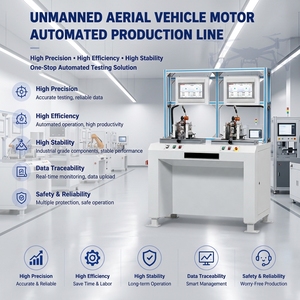
Integrated 100% automated quality station evaluating dielectric strength (Hipot), surge resistance, insulation resistance, and DC winding resistance in real-time.
Technical Performance Comparison Matrix
When evaluating production line investments, plant directors must weigh manually operated single-station equipment against modern fully integrated automated production lines. The technical matrix below illustrates the quantifiable productivity benefits delivered by Suzhou Haplin’s automated brushed stator production lines:
| Technical Parameter |
Traditional Semi-Auto Line |
Haplin Fully Automatic Stator Line |
Performance Impact |
| Takt Time (Sec/Unit) |
25 - 45 Seconds |
6 - 12 Seconds |
> 300% Output Boost |
| Direct Labor Requirement |
8 - 12 Operators |
1 - 2 Supervisory Operators |
up to 85% Labor Reduction |
| Winding Tension Variance |
± 8% (Mechanical Brake) |
± 1% (Closed-Loop Servo Control) |
Consistent Electrical Performance |
| Slot Insulation Defects |
~ 1.5% Failure Rate |
< 0.05% Failure Rate |
Near Zero Insulation Burnout |
| Traceability & MES Data |
Manual Paper Logging |
Full OPC-UA & Ethernet/IP Integration |
100% Industry 4.0 Compliance |
| Tooling Changeover Time |
2 - 4 Hours |
< 20 Minutes (Quick-Modular) |
Flexible Multi-SKU Production |
Future Procurement Trends in Brushed Stator Manufacturing Equipment
As global manufacturing shifts toward smart factories, carbon neutrality, and localized supply chain resilience, global procurement managers and process automation engineers are prioritizing equipment vendor solutions that offer long-term adaptability. Over the next 5 to 10 years, several core technology trends will redefine brushed stator production line procurement:
1. High-Density Slot Fill Ratios & Complex Wire Diameters
Modern electric motor designs push thermal efficiency limits by maximizing copper fill ratios inside stator slots. Procurement trends show growing demand for winding machinery capable of handling heavy wire gauges without scraping enamel insulation, as well as multi-strand parallel winding. Advanced tensioning algorithms and precision wire-guiding nozzles prevent wire crossing, reducing internal hot spots and extending motor operating lifespan.
2. Fast Servo-Driven Multi-SKU Tooling Changeovers
The era of dedicated single-product manufacturing lines is yielding to flexible, high-mix low-volume (HMLV) production environments. Motor manufacturers require stator production lines capable of switching between different stack heights, outer diameters, and winding turn counts within minutes. Suzhou Haplin equips its stator production lines with servo-indexed positioning, quick-lock mechanical fixtures, and recipe-based HMI controls, allowing operators to change over production runs with minimal downtime.
3. Closed-Loop In-Line Vision & AI Quality Control
Quality assurance is moving away from post-assembly sampling to real-time, in-line inspection. Next-generation stator production lines integrate high-resolution machine vision cameras at key manufacturing nodes—verifying slot insulation placement, detecting magnet tile micro-cracks, checking wire routing, and analyzing solder joint geometry before parts proceed to final assembly.
Strategic Procurement Insight: When selecting a Chinese manufacturing partner for stator production equipment, global buyers must assess not only initial hardware capital expenditures (CAPEX) but also operational expenditure (OPEX) efficiencies—including spare parts availability, remote software diagnostics, PLC control standardization (e.g., Siemens, Beckhoff, Omron), and local commissioning support.
Engineering Development Trends in Stator Assembly Automation
The engineering underlying brushed stator manufacturing is undergoing significant innovation to meet stringent noise, vibration, and harshness (NVH) requirements along with strict energy efficiency benchmarks. Key mechanical and electrical engineering developments include:
Energy-Efficient UV & Induction Curing
Replacing lengthy thermal curing ovens with localized induction heating and rapid UV-curing adhesive systems for magnetic tiles. Reduces energy consumption by up to 60% while shortening overall floor footprint.
Low-Noise Precision Stator Slotting
Advanced mechanical slotting techniques that eliminate burrs on lamination stacks. Clean slot geometry prevents insulation tears and guarantees smooth rotor-to-stator airgap uniformity.
Direct-Drive Rotary Servo Stations
Eliminating traditional belt-driven mechanisms in favor of direct-drive torque motors for stator indexing. Delivers sub-micron positioning accuracy, zero backlash, and significantly reduced maintenance downtime.