Precision Motor & Stator Manufacturing Equipment
Explore our high-performance automated assembly modules, CNC winding units, and turnkey stator production systems designed for global motor OEMs.
Engineering Industry White Paper: Next-Generation Stator Assembly Line Architecture
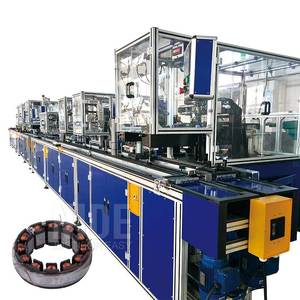
Electric motor manufacturing is undergoing a structural transition driven by higher efficiency standards (IE4/IE5 compliance), automotive electrification (EV traction motors), and industrial automation. At the heart of electric motor production is the stator assembly line—a sophisticated, highly integrated system that combines precision mechanics, multi-axis servo motion control, digital tensioning systems, and real-time automated optical inspection (AOI).
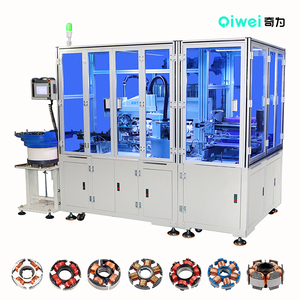
As China’s leading stator assembly line manufacturer, Suzhou Haplin Automation Equipment Co., Ltd. engineered automated solutions that eliminate manual assembly bottlenecks. Modern automated stator production lines integrate eight critical sequential phases:
1. Lamination & Paper Insertion
Automated feeding, stacking height measurement, and high-speed insulation paper insertion into stator slots with zero tearing or misalignment.
2. Insulating End-Cap Fitting
Robotic positioning of top and bottom plastic insulation caps or slot wedges, ensuring dielectric integrity prior to coil insertion.
3. Multi-Axis CNC Winding
Needle or flyer winding employing closed-loop tension controllers to maximize slot fill factor while maintaining wire enamel coating integrity.
4. Wire Termination & Crimping
Automatic lead wire stripping, terminal crimping, or hot-staking/laser welding for secure electrical connection across BLDC/Brushed phases.
5. Mid-Line End-Turn Lacing
High-speed lacing needles securing coil end turns to resist rotational vibration, mechanical torque spikes, and thermal expansion fatigue.
6. Impregnation & Varnishing
Controlled trickling or hot-dip varnish coating that bonds windings into a solid thermal mass for optimal heat dissipation and electrical isolation.
Information Gain Insight: Modern high-density BLDC stators demand slot fill factors exceeding 82%. Suzhou Haplin’s servo-guided needle winding heads achieve slot packing efficiency unmatched by traditional flyer winders, minimizing copper loss (I²R) and reducing stator core dimensions by up to 15% for equivalent torque output.
Technical Benchmark Comparison: Traditional vs. Fully Automated Stator Assembly
Selecting the correct manufacturing paradigm is crucial for plant managers evaluating capital expenditure (CAPEX) versus operational expenditure (OPEX). Below is an engineering evaluation comparing manual/semi-automated assembly against Haplin’s fully integrated automated stator production lines:
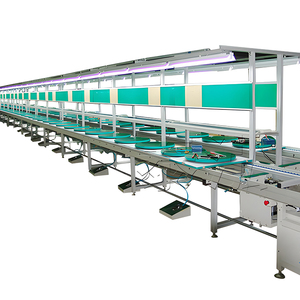
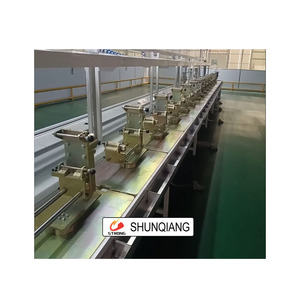
Manual assembly processes introduce human error, inconsistent coil tensioning, high scrap rates, and severe throughput bottlenecks. In contrast, fully automated stator lines feature centralized PLC control (Siemens S7-1500 / Beckhoff), EtherCAT bus communication, precision servo indexing tables, and automated double-speed chain conveyors that guarantee line balance and high Overall Equipment Effectiveness (OEE).
Key Engineering Subsystems in Modern Stator Manufacturing Lines
To achieve high repeatability and tight tolerances, several proprietary subsystems work in concert:
- Active Tensioning Controllers: Closed-loop tension control systems continuously monitor copper wire feed speed and tension force (measured in Newtons). This prevents stretching of the enamel coating, eliminating inter-turn short circuits during motor surge testing.
- Automatic Wedge Insertion: Precision servo-driven wedge cutters shape and insert slot wedges (made from DMD, NMN, or Nomex) to lock copper windings securely within the core slots.
- In-Line Surge & Hi-Pot Testing: Integrated diagnostic stations test 100% of stators for DC resistance, insulation resistance (IR), surge voltage breakdown, and AC dielectric strength prior to final potting or housing assembly.
Future Sourcing & Technological Trends in Stator Assembly (2025–2030)
Global procurement teams sourcing stator assembly equipment from China must align their capital investments with emerging technological macro-trends. As energy efficiency regulations tighten globally, stator manufacturing is rapidly evolving across four core fronts:
1. Dominance of BLDC & Permanent Magnet Synchronous Motor (PMSM) Architecture
Industrial applications, HVAC systems, power tools, and electric vehicles are aggressively replacing legacy brushed DC and induction motors with Brushless DC (BLDC) and PMSM technologies. Stator lines must handle inner-slot needle winding for concentrated pole configurations, requiring machine flexibility to transition between multi-pole outer-rotor and inner-rotor stator geometry.
2. Transition to Hairpin Stator Technology for EV & High-Power Motors
Hairpin (flat copper wire) winding technology is revolutionizing electric vehicle traction motors and industrial servo drives. Unlike round wire, rectangular copper conductors allow slot fill factors to exceed 88%, dramatically improving thermal conduction and torque density. Sourcing future-proof assembly lines requires suppliers capable of integrating automated flat wire bending, slot insertion, twisting, laser welding, and epoxy insulation coating.
3. Industry 4.0, OPC-UA Integration, and AI-Driven Quality Assurance
Modern smart factories require full digital traceability. Advanced stator assembly lines built by Suzhou Haplin feature industrial IoT gateways transmitting real-time operational data via OPC-UA protocols. Key parameters—such as winding tension curves, crimp force monitoring, laser welding thermal profile, and hi-pot test waveforms—are permanently bound to each stator’s laser-etched QR code for total traceability.
4. Sustainable Manufacturing: Zero-Waste & Energy-Efficient Trickling
Environmental regulations are accelerating the adoption of solvent-free trickling resin systems. Modern varnish impregnation units utilize induction heating instead of large thermal curing ovens, reducing energy consumption by up to 60% and eliminating volatile organic compound (VOC) emissions in the manufacturing facility.
Enterprise Superiority: Why Global Motor Makers Choose Suzhou Haplin Automation
Located in the advanced manufacturing hub of Suzhou, Jiangsu, China, Suzhou Haplin Automation Equipment Co., Ltd. (founded in November 2012) has established itself as an authoritative leader in electric motor assembly automation. Operating with a registered capital of RMB 15.2 million, a specialized team of over 70 automation engineers, and an annual production value surpassing RMB 65 million, Haplin integrates R&D, precision machining, assembly, software development, and global technical service.
E-E-A-T Commitment (Experience, Expertise, Authoritativeness, Trustworthiness): Every Haplin production line is custom-engineered around the buyer's exact lamination drawing, slot insulation requirement, wire gauge specifications, and target takt time—ensuring complete reliability before factory acceptance testing (FAT).
Core Enterprise Advantages
- Turnkey Engineering Competence: From standalone winding machines to fully automated end-to-end stator, rotor, and armature lines, Haplin designs complete mechanical, pneumatic, and control architectures in-house.
- Strict Quality Management & FAT Protocols: Prior to dispatch, all machinery undergoes rigorous continuous-run testing using actual customer-supplied stators and wire materials to verify line balance, cycle time, and zero-defect rate.
- Comprehensive Global Support Network: Haplin provides full English documentation, remote PLC online diagnostics, virtual FAT acceptance, on-site installation, and comprehensive operator training worldwide.
Stator Assembly Line Procurement FAQ (Frequently Asked Questions)
Below are essential engineering and commercial questions answered by our technical experts to assist procurement leaders in evaluating stator manufacturing solutions.
Q1: What specific technical information is required to receive a formal stator line proposal?
To engineer an accurate line design and cycle-time simulation, we require: (1) 2D/3D stator stack drawings including slot geometry and stack height, (2) Magnet wire diameter and insulation type, (3) Winding scheme (turns per coil, phase connection, delta/star), (4) Desired production capacity per shift (takt time), and (5) Local factory utility standards (voltage/frequency, compressed air pressure).
Q2: Can Haplin accommodate both inner-winding and outer-winding stator geometries?
Yes. We manufacture specialized CNC needle winders for inner-slot stators (commonly used in BLDC and PMSM motors) as well as high-speed flyer winding machines for outer-slot stators. Our modular winding heads can be retrofitted with quick-change tooling to support multiple stator stack heights on a single line.
Q3: How does your line ensure consistent wire tension during high-speed winding?
Our machines utilize active magnetic hysteresis or closed-loop electronic servo tensioners. These systems dynamically adjust tension in real-time according to the angular position of the winding needle, preventing wire stretch, enamel cracking, or uneven coil stack height.
Q4: What is the typical Factory Acceptance Testing (FAT) procedure for overseas buyers?
Before shipment, the complete assembly line is fully assembled in our Suzhou facility. We conduct a continuous production trial using your supplied stator cores and wire. Overseas clients can inspect the line in person or via high-definition multi-angle video FAT sessions where cycle time, OEE, scrap rate, and electrical test metrics are validated.
Q5: Can we start with standalone semi-automatic machines and upgrade to a fully automated line later?
Absolutely. Haplin’s machinery is built on a modular control platform. Customers frequently start with standalone winding, paper insertion, or spot welding units, and later connect them via automated double-speed chain conveyors, pallet indexing modules, and robotic pick-and-place units as production volume grows.
Q6: What after-sales service and spare parts support are provided internationally?
We provide comprehensive English operational manuals, complete electrical schematics, 24/7 remote technical support via secure VPN gateway, and fast dispatch of standardized wear parts (winding needles, wire guides, crimping dies). On-site commissioning and training by experienced field engineers are available globally.