Featured Motor Automation & Control Equipment
High-precision coil winders, brushless assembly systems, VFD controllers, and industrial soft starters designed for modern automated production lines.
Executive Overview: The Evolution of Industrial Motor Automation
The global transition toward high-efficiency motion control, electrified mobility, smart home automation, and energy-conscious HVAC systems has placed unprecedented operational demands on electric motor manufacturers. Modern industrial motor manufacturing relies heavily on automated production equipment to guarantee dimensional consistency, electrical performance, and high-volume output. As manufacturers phase out manual coil winding, labor-intensive armature assembly, and inconsistent insulation insertion, the market for motor automation equipment factories and wholesalers has undergone a seismic shift.
Today’s high-throughput motor factories require fully integrated, modular, and flexible automation lines capable of producing both classic Brushed DC (BDC) motors and high-efficiency Brushless DC (BLDC/PMSM) stators and rotors. Achieving high slot-fill factors, tight coil tension tolerances, optimal commutator spot-welding integrity, and real-time process monitoring are no longer optional—they are essential prerequisites for remaining competitive in the global B2B supply chain.
SEO & Sourcing Insight: Procurement managers evaluating original equipment manufacturers (OEMs) and machinery wholesalers must look beyond initial hardware acquisition costs. Total Cost of Ownership (TCO), multi-axis CNC repeatability, changeover efficiency, and factory acceptance test (FAT) verification standards serve as the core metrics for operational profitability.
Key Technological Drivers in Automated Motor Manufacturing
To assist global buyers, plant managers, and industrial equipment wholesalers in navigating the global supplier ecosystem, our engineering team evaluated leading production technologies across four core competencies:
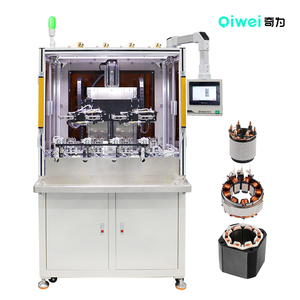
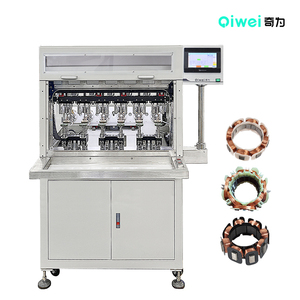
- Precision Needle & Flier Winding Architecture: Advanced multi-station CNC coil winders utilize closed-loop servo tension controllers to eliminate wire stretching or insulation damage during high-speed copper wire placement.
- Automated Armature & Stator Insulation: High-speed paper inserters and slot wedge positioning systems ensure 100% dielectric integrity prior to coil insertion.
- Integrated Spot Welding & Terminal Fusing: Double-head high-frequency inverter spot welders achieve uniform fusion across commutator risers, mitigating electrical resistance variations.
- End-of-Line (EOL) Automated Quality Verification: Machine-vision inspection combined with automated surge, resistance, and hi-pot testing guarantees zero-defect dispatch to downstream assembly lines.
Enterprise Benchmark Spotlight: Suzhou Haplin Automation Equipment Co., Ltd.
Founded in November 2012 and situated in the industrial hub of Suzhou, Jiangsu, China, Suzhou Haplin Automation Equipment Co., Ltd. (Haplin Automation) has established itself as an authoritative leader in custom electric motor manufacturing solutions. Operating with a registered capital of RMB 15.2 million, a dedicated team of over 70 multi-disciplinary automation engineers and technicians, and an annual output value surpassing RMB 65 million, Haplin integrates research and development, precision CNC machining, equipment assembly, and global after-sales support into a seamless operational framework.
Turnkey Customization
From custom lamination stack sizes and wire gauges to specific cycle times, Haplin tailors every production line directly to customer product blueprints.
Comprehensive Portfolio
Specializing in complete BLDC stator/rotor production units, brushed armature lines, magnetic tile assembly, and standalone CNC winding machinery.
Rigorous Factory Acceptance
All machinery undergoes full-cycle trial runs in Suzhou using actual buyer motor components to verify takt time and repeatability prior to shipment.
Haplin’s product catalog spans seven core equipment families serving power tool manufacturers, automotive micro-motor producers, industrial HVAC fan suppliers, e-mobility builders, and commercial appliance brands worldwide. By prioritizing robust mechanical design with intuitively configured PLC/HMI control interfaces, Haplin bridges the gap between high-capacity output and simplified operational maintenance.
Technical Analysis: Top 10 Factory Equipment Benchmarks
When selecting a motor manufacturing machinery supplier or wholesale controller provider, understanding technical operational boundaries is critical. Below is a structural matrix comparing standard industry benchmarks across prime automation equipment categories:
| Equipment Category | Automation Level | Primary Target Motors | Key Technical Parameter | Industry Efficiency Standard |
|---|---|---|---|---|
| BLDC Inner Winding Stator Line | Fully Automatic / Modular | Drone, Power Tools, HVAC Fans | Multi-axis Servo Needle Winding | ≤ 12 sec / stator coil set |
| Brushed Armature Line | Integrated Conveyor Line | Automotive Actuators, Home Appliances | Winding + Spot Welding Fusion | ≤ 6 sec / armature unit |
| CNC Transformer/Coil Winder | Semi-Auto / PLC CNC | Transformers, Solenoid Coils | 3KW Drive / 50kg Load Capacity | ± 0.05 turns accuracy |
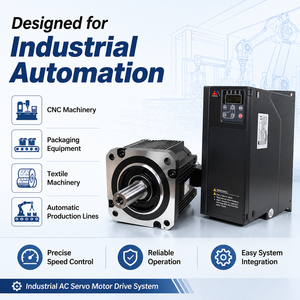
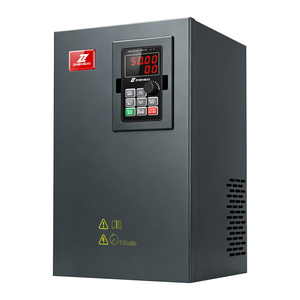
| High-Power VFD Drives | Digital Logic Control | Industrial Pumps, Heavy Fans | 380V 30kW–45kW 3-Phase Vector | ≥ 98% Drive Efficiency |
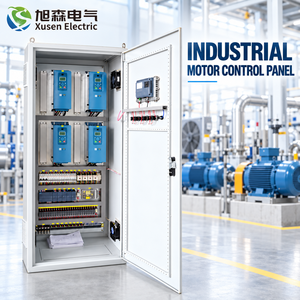
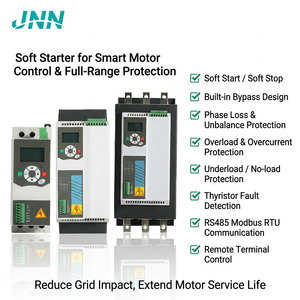
| Electronic Soft Starters | Solid-State SCR Control | AC Induction Motors, Compressors | Phase-Loss & Overload Protection | Smooth ramp-up in < 30 sec |
Future Trends in Motor Automation Procurement & Technology
As the global motor industry aligns with carbon-neutral mandates and Industry 4.0 smart factory standards, motor production equipment is undergoing rapid technological evolution. B2B purchasers and factory planners must align their equipment roadmap with four dominant market trends:
1. Hyper-Flexible Quick-Changeover Modular Lines
Modern motor factories are moving away from single-purpose, rigid machinery. Future-proof equipment features quick-tooling fixtures and digital recipe management within the HMI, allowing operators to switch between different rotor stack heights and stator laminations in under 15 minutes.
2. Closed-Loop Servo Tensioning & Real-Time Monitoring
With copper prices remaining high, reducing wire breakage and scrap rates is vital. Servo-driven wire tensioners automatically adjust feedback dynamic forces during high-speed winding, maintaining tight slot filling while preventing microscopic enamel micro-cracks.
3. Transition to Ultra-High-Efficiency BLDC & Hairpin Motors
While brushed motors maintain stable market share in cost-sensitive applications, global procurement trends show a rapid surge in BLDC stator inner-winding lines and EV hairpin stator assembly systems. Wholesalers and factories must stock versatile controllers and winders capable of managing complex multi-phase slot geometries.
4. IoT Connectivity & Predictive Maintenance Integration
Next-generation motor production lines come equipped with OPC-UA industrial protocol support. This allows centralized SCADA systems to capture real-time welding temperatures, winding speeds, and vibration analytics, predicting mechanical wear before unscheduled downtime occurs.
Frequently Asked Questions (FAQ) for Global Buyers
Expert answers to common engineering, procurement, and verification questions regarding motor automation machinery sourcing.
Accelerate Your Motor Production Lines Today
Connect directly with our senior automation engineers in Suzhou to request customized plant layouts, equipment technical specs, and complete pricing catalogs.