Featured Armature & Motor Assembly Production Lines
High-speed, ISO-certified automated manufacturing lines and specialized equipment engineered by Suzhou Haplin Automation Equipment Co., Ltd.
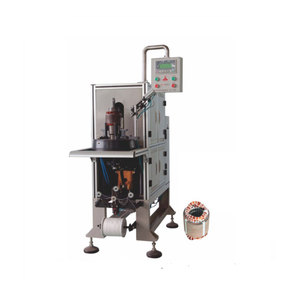
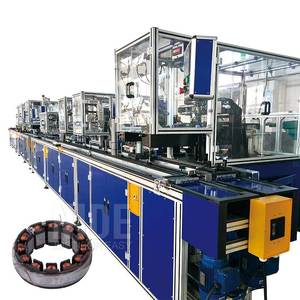
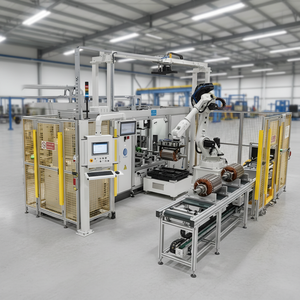
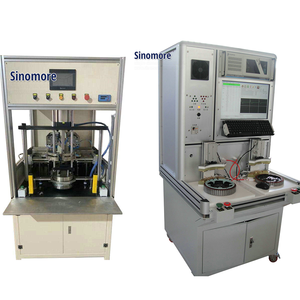
State of the Art in Armature Production Automation
Engineering baseline, technical trade-offs, and cycle-time optimization across modern rotor & armature manufacturing lines.
In the rapidly evolving landscape of electric motor manufacturing, the armature production line represents the critical heart of brushed DC motors, universal motors for power tools, home appliances, automotive micro-actuators, and high-torque industrial drives. As global demand shifts toward higher power density, stricter energy efficiency standards (IE3/IE4/IE5 compliance), and zero-defect tolerance, selecting the right manufacturing equipment partner in China has evolved from a basic machinery purchase into a strategic capital expenditure decision.
The End-to-End Armature Production Workflow
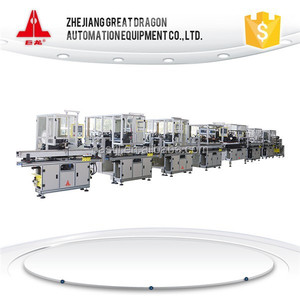
A fully automatic armature manufacturing system systematically links five fundamental manufacturing phases to convert raw lamination stacks, copper wire, shaft stock, and commutators into fully tested, high-performance rotors:
- Phase 1: Core Prep & Insulation: Automatic shaft pressing followed by high-speed insulating paper insertion (or epoxy powder coating) into armature slots.
- Phase 2: Precision Winding & Hooking: Dual-flyer high-speed winding with real-time wire tension control, seamlessly wrapping copper wire into hooks on the commutator.
- Phase 3: Fusing & Hot Staking: Resistance hot-staking spot welding that bonds wire leads to commutator segments with zero-porosity weld joints.
- Phase 4: Resin Impregnation & Curing: Trickle or drip resin application followed by controlled induction heating to eliminate air voids and reinforce coil mechanical strength.
- Phase 5: Finishing & Testing: Commutator diamond turning/undercutting, dynamic double-plane balancing, and 100% inline electrical safety testing (Surge, Hi-Pot, Resistance).
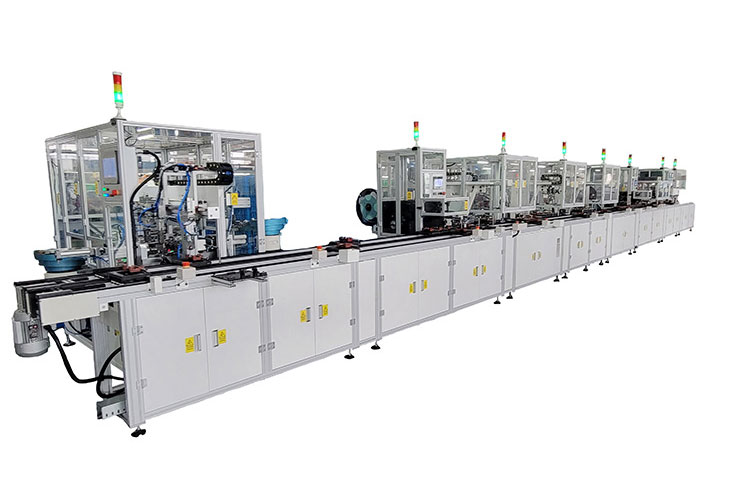
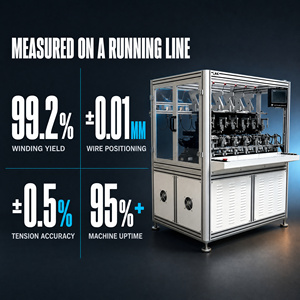
Haplin Armature Line Benchmark Specs
Verified performance metrics from Suzhou Haplin Automation Equipment Co., Ltd. turnkey deployments
Architectural Comparison: Armature Line Automation Levels
Evaluate capital expenditure (CapEx), operational efficiency (OpEx), and flexibility across different production line configurations.
| Performance Criteria | Standalone Cell Machines | Semi-Automatic Modular Line | Turnkey Fully Automatic Line |
|---|---|---|---|
| Typical Throughput / Shift (8 hrs) | 800 – 1,200 units | 2,500 – 3,800 units | 4,500 – 6,500+ units |
| Direct Labor Requirement | 4 – 6 Operators | 2 – 3 Operators | 1 Supervisory Technician |
| Takt Time Range | 25 – 35 Seconds | 12 – 18 Seconds | 6 – 10 Seconds |
| Changeover Flexibility | High (Manual Tooling Adjustment) | Medium (Quick-release Fixtures) | Servo-Driven Digital Quick Changeover |
| Initial Investment (CapEx) | Low baseline | Moderate | Optimized for Long-term TCO |
| Best Suited Application | High-mix / Low-volume R&D & Repair | Growing Mid-scale Motor Factories | Tier-1 Automotive & OEM Mass Production |
Technical Excellence in Haplin Armature Equipment
Why leading global motor manufacturers trust Suzhou Haplin Automation for critical armature & rotor production equipment.
Closed-Loop Servo Flyer Winding
Utilizes active magnetic tensor closed-loop feedback control. Prevents enamel wire stretching or micro-cracking, guaranteeing ultra-consistent coil electrical resistance and slot fill factor up to 78%.
Inverter Hot-Staking Spot Welding
High-frequency inverter welding technology monitors voltage drop, displacement, and temperature simultaneously during commutator fused-junction formation, eliminating cold welds and burned insulation.
Dynamic Dual-Plane Balancing
Integrated high-precision optical sensors isolate residual unbalance down to ≤0.05 g·mm/kg. Auto-milling or V-groove cutting removes mass dynamically without disturbing armature structural integrity.
Modular Conveyor Architecture
Heavy-duty pallet-based friction conveyors allow independent station operation, buffer accumulation, and seamless integration of third-party inspection units or robotic loading arms.
100% Comprehensive Safety Testing
Integrated multi-function electrical testing station evaluates inter-turn surge insulation, dielectric strength (Hi-Pot), insulation resistance, and segment-to-segment resistance automatically.
Smart Factory & MES Connectivity
Full OPC-UA, Ethernet/IP, and Modbus TCP protocol compliance. Real-time yield monitoring, predictive maintenance alerts, and batch parameter logging stored directly to factory MES databases.
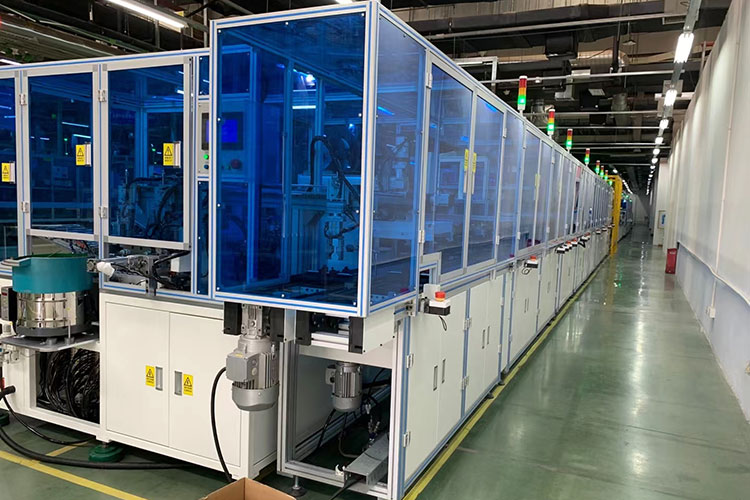
High-Speed Brushed Rotor Assembly Engineering
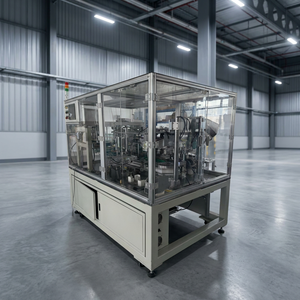
Suzhou Haplin's brushed motor rotor production units combine compact physical footprint with industrial-grade durability. Built around rigid steel frames and premium core components (PLC, pneumatic cylinders, servo drives), our equipment operates continuously in demanding multi-shift manufacturing environments worldwide.
Future Sourcing & Procurement Trends in Armature & Motor Lines
Key technological shifts that procurement managers and automation directors must evaluate before placing plant equipment orders.
The Dual-Track Coexistence: Brushed Upgrade vs. BLDC Transition
While Brushless DC (BLDC) and Permanent Magnet Synchronous Motors (PMSM) continue to capture market share in premium power tools and automotive EVs, high-torque brushed DC motors and universal armatures remain unbeatable in cost-sensitive, high-starting-torque applications. Leading manufacturers are investing in flexible lines capable of rapid adaptation between brushed armature winding and BLDC inner-stator winding configurations.
AI Vision Inspection Replacing Manual Quality Audits
Modern armature suppliers are embedding high-resolution CMOS industrial camera vision systems at winding, paper insertion, and spot welding stations. AI deep-learning vision models check slot paper overlap, wire crossover misalignments, and commutator hook flash in under 50 milliseconds, preventing defective armatures from advancing to costly resin impregnation stages.
Servo-Driven Fast Recipe Changeovers
In response to shorter product lifecycles and high-mix low-volume (HMLV) manufacturing mandates, traditional mechanical cam-driven armature equipment is being superseded by multi-axis servo systems. Operators can execute full product line changeovers (adjusting armature stack height, diameter, slot count, and winding pitch) within 15 minutes via HMI recipe selection.
Carbon Footprint & Energy-Efficient Curing
Environmental sustainability mandates are driving the replacement of traditional energy-intensive thermal curing ovens with rapid induction trickling systems and UV-assisted resin curing. This reduces electricity consumption by up to 45% while decreasing the thermal footprint on the manufacturing plant floor.
Why Partner with Suzhou Haplin Automation Equipment Co., Ltd.
A engineering-driven manufacturer dedicated to customized electric motor assembly lines since 2012.
Founded in November 2012 in the advanced manufacturing hub of Suzhou, Jiangsu Province, China (No.35 Aige Hao Road, Weitang Town, Xiangcheng District), Suzhou Haplin Automation Equipment Co., Ltd. stands as a premier high-tech enterprise integrating R&D, precision assembly, global sales, and full lifecycle after-sales engineering support.
- Capital & Capacity Baseline: RMB 15.2 Million registered capital, 70+ skilled engineers and automation technicians, generating over RMB 65 Million in annual equipment output.
- Comprehensive Portfolio: 7 core equipment families spanning brushed armature lines, BLDC stator inner winding units, magnetic tile placement systems, and EV motor rotor assembly setups.
- Quality & Governance: ISO 9001 certified quality control system. Every armature line undergoes rigorous 72-hour continuous endurance trial runs with customer actual samples prior to factory delivery (FAT).
- Global Engineering Reach: Export-grade English PLC software interfaces, standardized schematic documentation, and dedicated remote/onsite commissioning assistance across North America, Europe, Southeast Asia, and South America.
Strict Factory Acceptance Testing (FAT)
Customers verify line speed, takt time, and first-pass yield in our Suzhou facility physically or via 4K live video stream prior to dispatch.
Customized Tooling & Modular Fixtures
Engineering drawings are adapted directly to your specific motor lamination profile, wire gauge, and stack height specifications.
Lifetime Spare Parts & Remote Support
Standardized wear components (winding flyers, paper insertion cutters, welding heads) shipped worldwide with rapid response SLAs.
Frequently Asked Questions for Armature Line Buyers
Essential answers to common engineering, commercial, and technical queries regarding custom motor equipment procurement in China.
What specific armature dimensions and wire gauges can your production lines handle?
What core technical information is needed to obtain a fast and accurate formal quotation?
- Detailed 2D/3D technical drawings of your armature (core, shaft, commutator, wire turns, slot count).
- Required target output (units per 8-hour shift or target takt time per rotor).
- Desired level of automation (standalone machines, semi-automatic line, or fully automatic connected line).
- Local plant power specifications (e.g., 220V/380V/415V/480V at 50Hz/60Hz) and safety certifications required (CE, UL, ISO).
Can we start with individual standalone armature machines and integrate them into a fully automated line later?
How does Haplin conduct Factory Acceptance Testing (FAT) for international buyers?
What after-sales service, installation, and spare parts support are provided globally?
What is the typical production lead time for a turnkey armature production line?
Accelerate Your Motor Assembly Automation Today
Send us your armature product drawings, wire specs, and target output. Our senior automation engineers will analyze your requirements and deliver a detailed technical proposal and ROI assessment within 24 hours.