High-Efficiency Motor Winding & Assembly Machinery
Engineered for high slot-fill ratios, automated production lines, and heavy-duty industrial continuous output in Bien Hoa manufacturing zones.
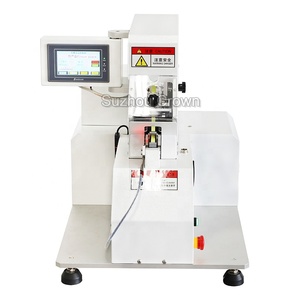
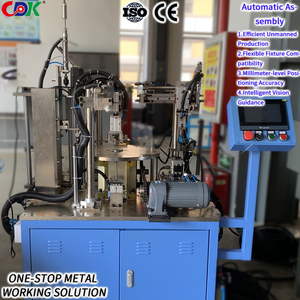
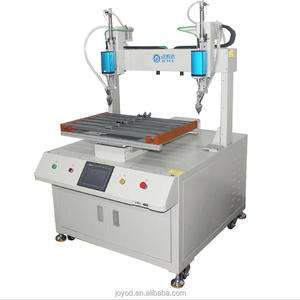
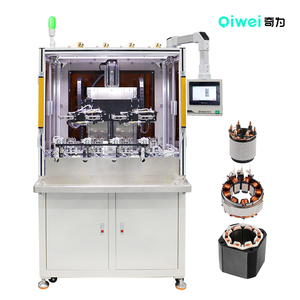
Technical Whitepaper: Segmented Stator Winding Dynamics in Next-Gen Electric Motors
In the realm of modern electromechanical engineering, the industrial motor sector is undergoing a profound paradigm shift. Traditional integral (unibody) stator designs are increasingly reaching their mechanical and electromagnetic limits when tasked with fulfilling super-premium energy efficiency standards (IE4 and IE5) mandated by international regulatory frameworks. To overcome the structural constraints of narrow slot openings in continuous stator laminations, electrical machine designers are adopting segmented stator topology (individual tooth winding or tooth-chain assembly).
This technical whitepaper examines the core electromagnetic, thermal, and manufacturing mechanics of Segmented Stator Winding Machines, highlighting how direct needle-winding on isolated T-tooth geometries unlocks unprecedented torque density, drastic copper-loss reduction, and thermal superiority for industrial motor manufacturers operating in Bien Hoa, Dong Nai Province, Vietnam.
1. The Physics of Slot Fill Factor: Integral vs. Segmented Tooth Architecture
The primary bottleneck in conventional inner-winding or outer flyer-winding on integral stators is the mechanical clearance required for the winding needle or flyer arm to navigate through the narrow stator slot opening ($w_s$). In continuous stator cores, the copper slot fill ratio ($\eta_{fill}$) rarely exceeds 45% to 52% due to overlapping wire paths, randomized winding structure, and slot mouth interference.
By segmenting the stator core into discrete poles (single teeth) or flexible tooth chains, the slot opening is effectively opened up to $180^\circ$ during the winding phase. This unrestricted spatial access allows high-precision CNC needle-winding machines to execute true orthocyclic precision winding (layered precision placement). As a consequence:
- Copper Slot Fill Factor ($\eta_{fill}$): Escalates from ~48% in conventional integral stators up to 75% - 82% in segmented tooth configurations.
- Ohmic Resistance Reduction ($R_{cu}$): Orthocyclic layer winding eliminates randomized wire crossing, shortening end-winding overhangs by up to 30%, which directly decreases total phase resistance and copper mass.
- Thermal Dissipation Coefficients: Densely packed rectangular or circular conductors with minimal air voids drastically lower internal thermal resistance ($\theta_{ja}$), allowing rapid heat transfer from the core copper turns to the outer iron lamination stack.
Higher Slot Fill Factor
Direct needle winding on T-shaped teeth increases copper fill factor to over 78%, delivering superior torque density and operational efficiency.
Joule Loss Minimization
Shorter coil overhangs eliminate unnecessary copper length, significantly reducing $I^2R$ resistive heating and power loss during high-load output.
Automated Takt Efficiency
High-speed multi-axis CNC tensioners and automatic terminal wire wrapping enable cycle times down to 12 seconds per stator segment module.
2. Comparative Engineering Analysis: Manufacturing Methodologies
Selecting the optimal stator production architecture depends heavily on motor topology, volume requirements, and target energy ratings. The comparative matrix below outlines key performance indicators across three primary winding methodologies utilized by global OEM manufacturers:
| Parameters / Topology | Integral Stator Flyer Winding | Integral Stator Needle Winding | Segmented Stator CNC Needle Winding |
|---|---|---|---|
| Slot Fill Factor ($\eta_{fill}$) | 38% - 48% | 48% - 58% | 72% - 82% (Orthocyclic) |
| End-Winding Overhang Height | High (Uncontrolled) | Medium | Minimal (Precision Stacked) |
| Automated Terminal Pin Wrapping | Difficult / Semi-manual | Supported | 100% Fully Automated CNC |
| Wire Tension Control | Frictional Mechanical | Closed-Loop Electronic | Closed-Loop Servo Closed-Tension |
| Suitable Motor Types | Low-cost Universal Motors | Standard Brushless DC (BLDC) | High-Torque PMSM, EV Traction, IE5 Industrial |
Localized Applications in Bien Hoa & Dong Nai Industrial Ecosystem
Deploying specialized motor manufacturing automation tailored to the operational demands of Southern Vietnam's premier industrial corridor.
Bien Hoa City, as the administrative and industrial epicenter of Dong Nai Province, represents one of Vietnam's most sophisticated manufacturing clusters. Hosting premier industrial zones such as Bien Hoa Industrial Zone I & II, Amata Industrial Park, Loteco Industrial Zone, Tam Phuoc IZ, and Agrotex IZ, the regional supply chain is rapidly modernizing from low-margin assembly to advanced electro-mechanical manufacturing.
Our segmented stator winding machinery and automated motor production lines are specifically configured to address localized operational requirements across key industries in Bien Hoa:
Tropicalized Electrical Engineering
Bien Hoa experiences extreme tropical monsoon conditions with average ambient relative humidity reaching 85-90% during monsoon seasons. All machines exported to Dong Nai feature IP54-rated sealed control cabinets, anti-corrosion chrome-plated linear guide rails, internal cabinet dehumidifiers, and anti-fungal coated PCB assemblies.
Industrial Pump & HVAC Compressor Motors
Facilities in Amata and Loteco producing heavy-duty commercial HVAC compressors, agricultural irrigation pumps, and wastewater aeration motors utilize our high-torque 3KW - 15KW segmented stator winding machines to build IE4-rated motors capable of withstanding continuous 24/7 duty cycles.
E-Mobility & Electric Two-Wheelers
With Vietnam's rapid transition toward electric scooters and e-motorbikes, localized Tier-1 suppliers in Dong Nai employ our modular segmented winding lines to produce high-density hub motors and mid-drive PMSM electric powertrains with minimal capital expenditure.
Customized Power Supply & Grid Compliance for Dong Nai Factories
Factories in Bien Hoa operate under a nominal 380V / 3-Phase / 50Hz industrial grid, occasionally subject to localized line-voltage fluctuations during peak load hours. All Haplin automation units shipped to Bien Hoa are equipped with multi-tap isolation transformers, Siemens or Mitsubishi PLC power line filters, and heavy-duty transient surge protection to guarantee 99.8% uptime.
Inquire NowIndustrial Development Trends & Efficiency Mandates in Vietnam
The manufacturing landscape in Southern Vietnam is undergoing rapid transformation driven by stringent government energy policies and shifting global supply chain dynamics. Three major trends define the procurement strategies of motor manufacturing plants in Bien Hoa:
1. Transition to IE3 & IE4 Minimum Energy Performance Standards (MEPS)
Under Vietnam's National Energy Efficiency Program (VNEEP 3) and Decision No. 14/2023/QD-TTg, low-efficiency industrial electric motors are systematically being phased out of import and domestic sales. Motor factories across Dong Nai are retrofitting production lines from traditional induction designs to Permanent Magnet Synchronous Motors (PMSM) and BLDC architectures. Segmented stator winding technology is the fundamental enabler for achieving the elevated slot fill ratios required by IE4 and IE5 efficiency ratings without increasing the overall physical frame size of the motor.
2. Shift from Manual Assembly to Industry 4.0 Flexible Lines
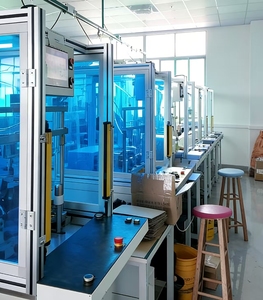
Rising labor costs in Southern urban centers like Bien Hoa and Ho Chi Minh City are compelling enterprise executives to automate critical manufacturing processes. Automated segmented stator production lines integrate CNC needle winding, servo insulation insertion, laser terminal welding, and automated vision testing into a unified SCADA network. Real-time data logging via Modbus TCP or OPC-UA enables full traceability for every individual stator assembly manufactured in Bien Hoa facilities.
3. Growth of the Civilian Drone & Precision Micro-Motor Ecosystem
Beyond traditional industrial motors, the expansion of high-tech manufacturing in nearby enterprise zones (such as HCMC High-Tech Park and Long Thanh District) has sparked unprecedented demand for micro-segmented BLDC stators. Specialty flexible assembly lines—such as our Flexible Brushless Motor Production Line for Civilian FPV Drones—enable local factories to dynamically switch between stator stack heights and magnetic pole configurations with software-guided toolless changeovers in under 15 minutes.
End-to-End Segmented Stator Manufacturing Process
From raw lamination stacks to fully resin-encapsulated high-performance BLDC stator assemblies.
Lamination Stacking & Insulation
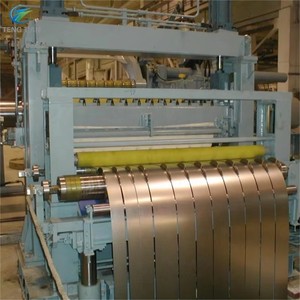
Silicon steel laminations are precision-stacked and fitted with high-dielectric bobbin insulations or directly coated via electrostatic epoxy powder spray to maximize slot usable area.
CNC Servo Needle Winding
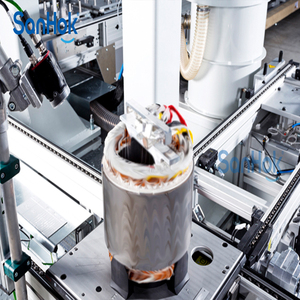
Individual T-teeth or connected tooth-chain elements are clamped into high-speed CNC indexing fixtures. Multi-axis servo needles lay copper wire in perfect orthocyclic arrangements with continuous tension feedback.
Terminal Pin Wrapping & Cut
The winding needle automatically executes multi-turn mechanical wire wrapping around plastic bobbin terminal pins or lead slots before precision mechanical blades perform zero-tail wire cutting.
Laser / Resistance Welding
Automated spot welding modules bond enamel wire ends to terminal pins or copper busbars, eliminating manual soldering while ensuring vibration-resistant electrical connections.
Tooth Press-Fit & Ring Yoke Assembly
Wound single teeth are collected by high-precision mechanical press stations, aligned into a circular matrix, and hydraulic or servo-driven into the continuous outer stator yoke sleeve.
Surge, Hi-Pot & Resistance Testing
Integrated end-of-line testing units automatically evaluate phase resistance ($R_{phase}$), surge insulation voltage breakdown, and inter-turn short circuits before releasing parts to final assembly.
Frequently Asked Questions by Buyers in Bien Hoa
Addressing key operational, technical, and logistical questions for motor manufacturers in Dong Nai Province.
What are the primary technical advantages of purchasing a Segmented Stator Winding Machine over traditional continuous stator machinery for our Bien Hoa factory?
+
Can your equipment accommodate our custom stator dimensions and specialized copper wire gauges?
+
How are shipping, customs clearance, and logistics managed from your Suzhou facility to industrial zones in Dong Nai / Bien Hoa?
+
What local technical installation, commissioning, and operator training services do you offer in Southern Vietnam?
+
How does the machinery perform under the high humidity and temperature environment typical of Dong Nai Province?
+
What is the typical return on investment (ROI) timeline for automated segmented stator production lines in Vietnam?
+
Can we begin with a single standalone winding machine and expand into a fully automated turnkey assembly line later?
+
Suzhou Haplin Automation Equipment Co., Ltd.
Your Trusted Global Engineering Partner in Brushless & Brushed Motor Manufacturing Equipment
Founded in November 2012 in the high-tech industrial hub of Suzhou, Jiangsu Province, China, Suzhou Haplin Automation Equipment Co., Ltd. has established itself as an authoritative leader in the research, development, custom design, and fabrication of specialized electric motor production equipment.
Operating with a registered capital of RMB 15.2 million and a highly skilled workforce of over 70 automation engineers, mechanical designers, and technical specialists, Haplin delivers over RMB 65 million in annual equipment output value to motor manufacturers across Asia, Europe, and the Americas.
ISO 9001 & CE Certified Quality
All machinery conforms strictly to international safety and quality protocols, incorporating CE-marked safety light curtains, emergency stop circuits, and heavy-duty structural steel frames.
Turnkey Engineering Approach
We do not sell off-the-shelf compromise solutions. Our team analyzes your specific lamination drawings, coil turns, and target shift output to engineer dedicated tooling and optimized PLC winding motion profiles.
Complete Ecosystem Coverage
From individual coil winders and paper inserters to complete turnkey BLDC stator lines, rotor assembly units, and automatic magnetic tile insertion systems, our portfolio covers every phase of motor production.
Upgrade Your Motor Manufacturing Facility in Bien Hoa
Partner with Suzhou Haplin Automation Equipment Co., Ltd. to implement high-density segmented stator winding technology, elevate your product energy efficiency, and lower production unit costs. Our engineering team is ready to evaluate your stator samples and provide custom line proposals.
Inquire Now