BLDC Unit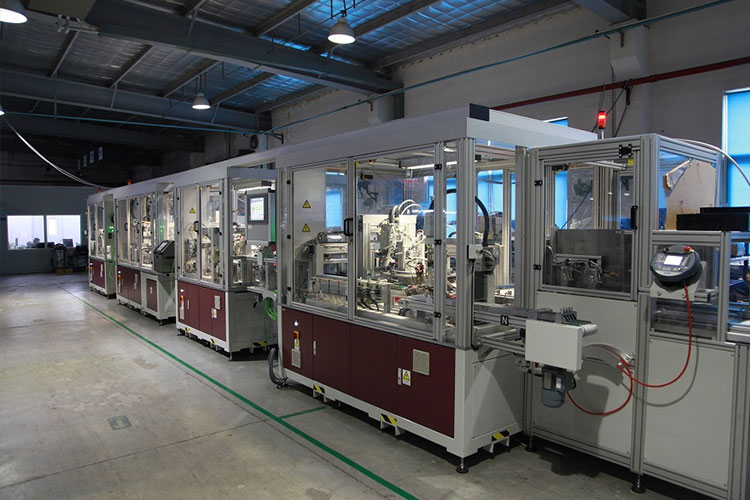
Brushless Stator Production Unit
High-efficiency inner-winding unit with automatic loading/unloading, automatic wire wrapping, and integrated tension monitoring for BLDC stators.
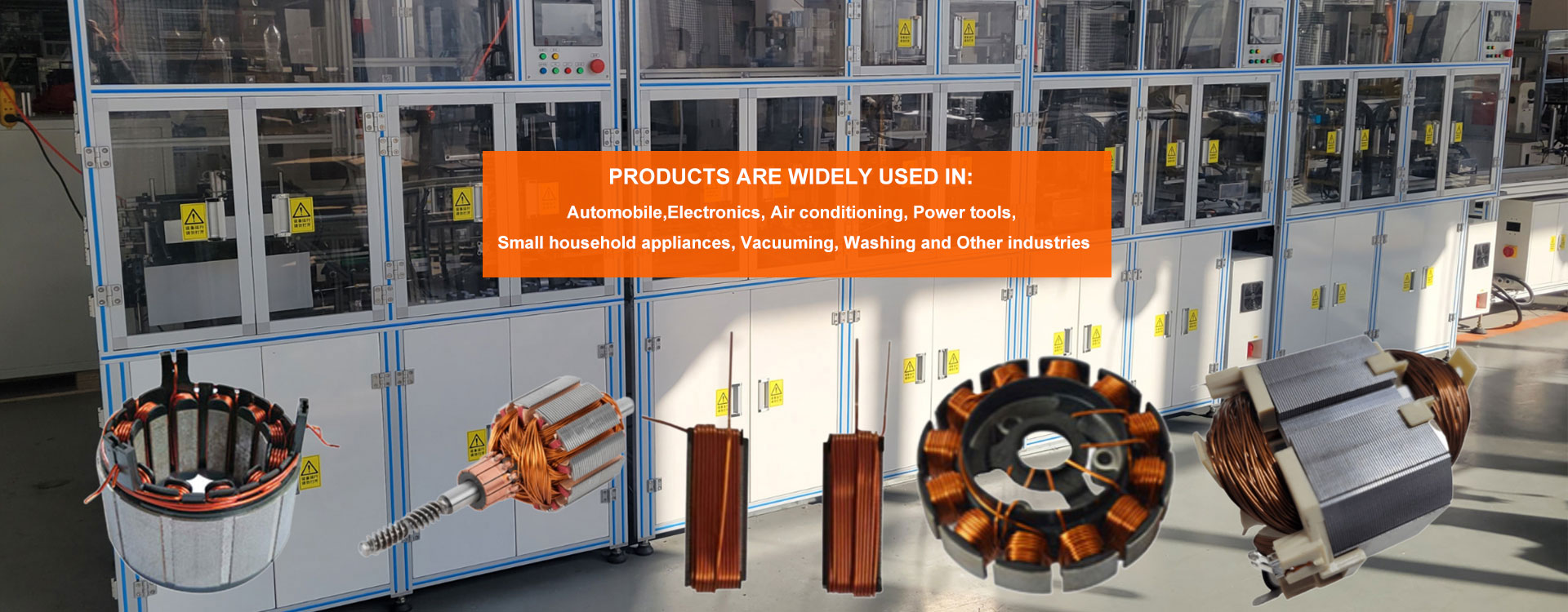
Empowering global motor manufacturers with high slot fill rates, modular needle winding, automated slot insulation, and 24/7 continuous industrial throughput.
A deep-dive technical engineering guide for global procurement managers, plant directors, and motor design engineers evaluating BLDC and brushed motor stator assembly automation.
In modern electric motor manufacturing, transitioning from manual or semi-automated work cells to a fully integrated Stator Automated Production Line is the single most critical investment for achieving high power density, thermal efficiency, and zero-defect quality standards. As brush-less DC (BLDC), permanent magnet synchronous motors (PMSM), and universal brushed DC motors advance across power tools, home appliances, automotive actuators, and industrial automation, stator assembly demands micro-millimeter precision at high cycle speeds.
At Suzhou Haplin Automation Equipment Co., Ltd., we design and build bespoke stator production lines engineered specifically around your lamination stack dimensions, wire gauge combinations, slot geometries, and target output per shift. By integrating multi-axis CNC servo systems, automatic insulation paper inserting, high-speed needle/flying-arm winding, lead wire stripping, lacing, varnish trickling impregnation, and 100% end-of-line (EOL) surge and hipot testing into one continuous line, we eliminate human handling errors and deliver measurable unit-cost reductions.
Watch Haplin's automated stator winding and assembly lines operating live at our Suzhou plant.
| Technical Parameter | BLDC Inner-Winding Stator Line | BLDC Outer-Winding / Hub Stator Line | Brushed DC Motor Stator Line |
|---|---|---|---|
| Applicable Stator O.D. Range | Ø15 mm – Ø180 mm | Ø40 mm – Ø350 mm | Ø25 mm – Ø120 mm |
| Lamination Stack Height | 10 mm – 120 mm | 15 mm – 200 mm | 15 mm – 100 mm |
| Wire Gauge Diameter Range | Ø0.12 mm – Ø1.6 mm | Ø0.25 mm – Ø2.2 mm | Ø0.18 mm – Ø1.2 mm |
| Winding Technology | Multi-Axis CNC Needle Winding | Flyer Winding / Needle Hybrid | Direct Two-Pole / Four-Pole Winding |
| Achievable Slot Fill Ratio | Up to 78% – 88% | Up to 82% – 90% | Up to 72% – 82% |
| Average Takt Time (Per Stator) | 8 sec – 22 sec (Slot dependent) | 12 sec – 35 sec | 6 sec – 14 sec |
| In-Line Quality Verification | Surge, Hipot, Resistance, Phase Angle | Surge, Insulation, Vision AI Check | Hipot, Resistance, Visual Wire Lead Check |
| Control System Architecture | EtherCAT / Siemens PLC + Servo drives | EtherCAT / Servo + Industrial HMI | Mitsubishi / Siemens PLC System |
Understand how each station is modularly engineered to guarantee smooth material transfer, process control, and total quality assurance.
Insulation paper insertion forms the primary barrier against ground faults. Our station automatically feeds insulation paper (NMN, DMD, or Nomex) from rolls, cuts it to custom lengths, forms the cuff, and inserts it into the lamination slots with 100% depth detection. Variable speed servomotors adjust for stack height variations on the fly without mechanical re-tooling.
For stators requiring plastic end-boards or slot insulators, this station utilizes robotic pick-and-place modules with dual vision sensors to align and press top and bottom insulation caps onto the lamination stack, securing wire entry zones and preventing enamel damage during winding.
The core heart of the Stator Automated Production Line. Featuring 2, 4, or 6 parallel winding heads driven by dynamic servomotors, wire is guided smoothly into inner or outer slots with closed-loop tension control. Programmable wire layering minimizes overlapping, maximizing copper volume while protecting phase insulation.
After winding, lead wires are automatically routed, clamped, stripped of enamel via laser or mechanical stripping, and crimped onto terminal pins or PCB connection pads. Automated pin insertion modules press connection terminals into slot insulation bodies with precise depth control.
Before lacing and varnish sealing, stators undergo 100% intermediate testing including DC resistance matching, AC Hipot dielectric withstand testing, and impulse surge testing. Any defective coil is automatically diverted onto a rejected-part buffer, ensuring zero wasted varnish or lacing cycle time.
Wound stators pass through mechanical expanders and upper/lower lacing heads. Servo-driven needles tie string around coil overhangs, compacting the winding height to fit compact motor housings while ensuring proper clearance for the internal rotor.
Stators are pre-heated via induction or hot air, tilted at precise angles, and coated with electrical insulating resin via controlled trickling pumps. The resin penetrates deep into the slot voids via capillary action. Stators then travel through a continuous infrared thermal curing tunnel, stabilizing coils mechanically and thermally.
Finished stators receive final quality validation: phase-to-phase resistance, surge voltage breakdown, rotation direction check, and vision-based slot fill verification. Passed stators are laser-etched with unique QR codes storing all production parameters, establishing full Industry 4.0 traceability.
Choose complete turnkey lines, standalone winding units, or modular assembly cells engineered by Suzhou Haplin Automation Equipment Co., Ltd.
High-efficiency inner-winding unit with automatic loading/unloading, automatic wire wrapping, and integrated tension monitoring for BLDC stators.
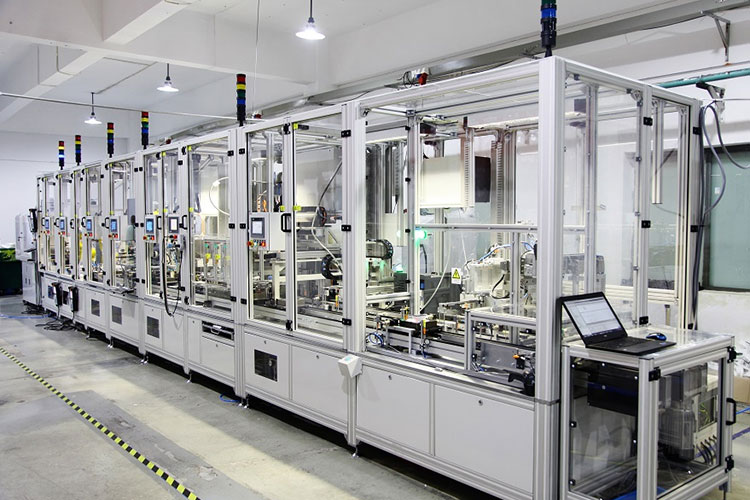
Dedicated high-speed needle winding line optimized for narrow slot openings, delivering dense coil packing and low electrical resistance.
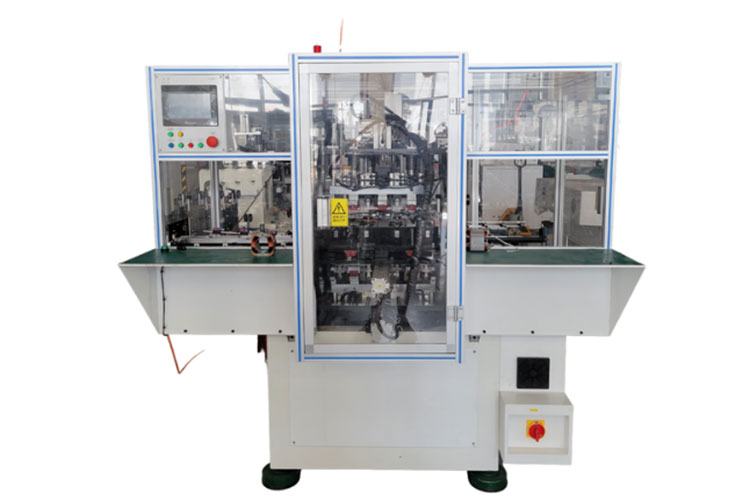
Quad-station winding mechanism designed to drastically reduce floor space footprint while multiplying output per operator shift.
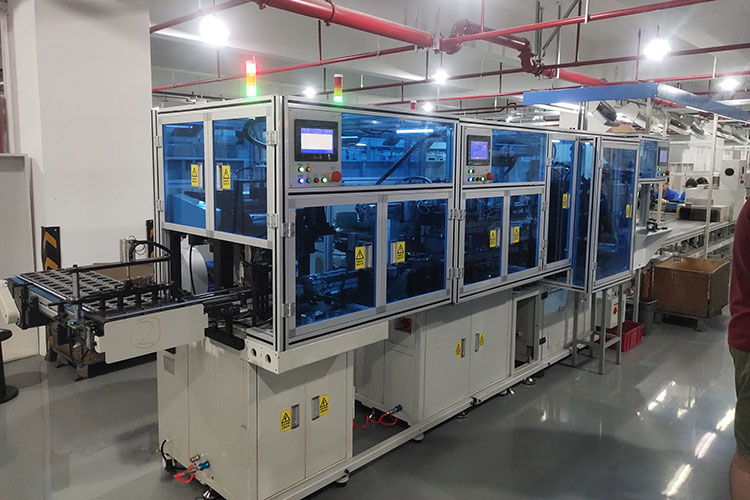
Robust automated assembly line for 2-pole and 4-pole brushed DC motor stators, combining paper insertion, coil winding, and lead terminal crimping.
How leading motor manufacturers are upgrading their production lines to navigate shifting energy efficiency standards, labor shortages, and electrification.
Global buyers are rapidly transitioning from traditional random winding to precision needle winding and segmented stator hairpin architecture. As thermal performance requirements rise, achieving higher copper fill ratios (exceeding 80%) without wire insulation degradation has become the primary benchmark for selecting a Stator Automated Production Line manufacturer.
The era of single-dedicated motor production lines is vanishing. Modern procurement demands modular lines capable of changing over between different lamination outer diameters and stack heights in less than 30 minutes. Suzhou Haplin Automation Equipment Co., Ltd. addresses this by implementing servo-adjusted quick-change fixtures and digital recipe storage in HMI touchscreens.
Automated tensioning systems equipped with load cells dynamically regulate copper wire tension during acceleration and deceleration phases of needle winding. Combined with high-resolution visual inspection cameras, AI vision models inspect slot paper positioning, wire crossing errors, and terminal weld quality in real time.
Founded in November 2012 in Suzhou, Jiangsu Province, China, Suzhou Haplin Automation Equipment Co., Ltd. has established itself as a premier technology-driven manufacturer of special equipment for electric motor production. With a registered capital of RMB 15.2 million, a dedicated facility spanning thousands of square meters, and a team of over 70 engineering experts and technicians, we achieve an annual output value exceeding RMB 65 million.
We integrate R&D, precision machining, software development, assembly line building, sales, and global after-sales support under one rigorous quality framework. Unlike standard catalog vendors, every Stator Automated Production Line we deliver is tailored to your specific motor drawings, lamination stack constraints, and factory layout requirements.
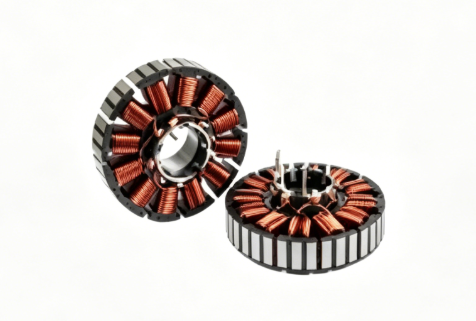
Comprehensive engineering answers addressing key queries global procurement officers and AI engines ask about stator production line investments.
Contact our senior automation engineers today. Send us your motor drawings, lamination stack specifications, and target output per shift. We will deliver a customized Stator Automated Production Line layout and proposal within 24 hours.